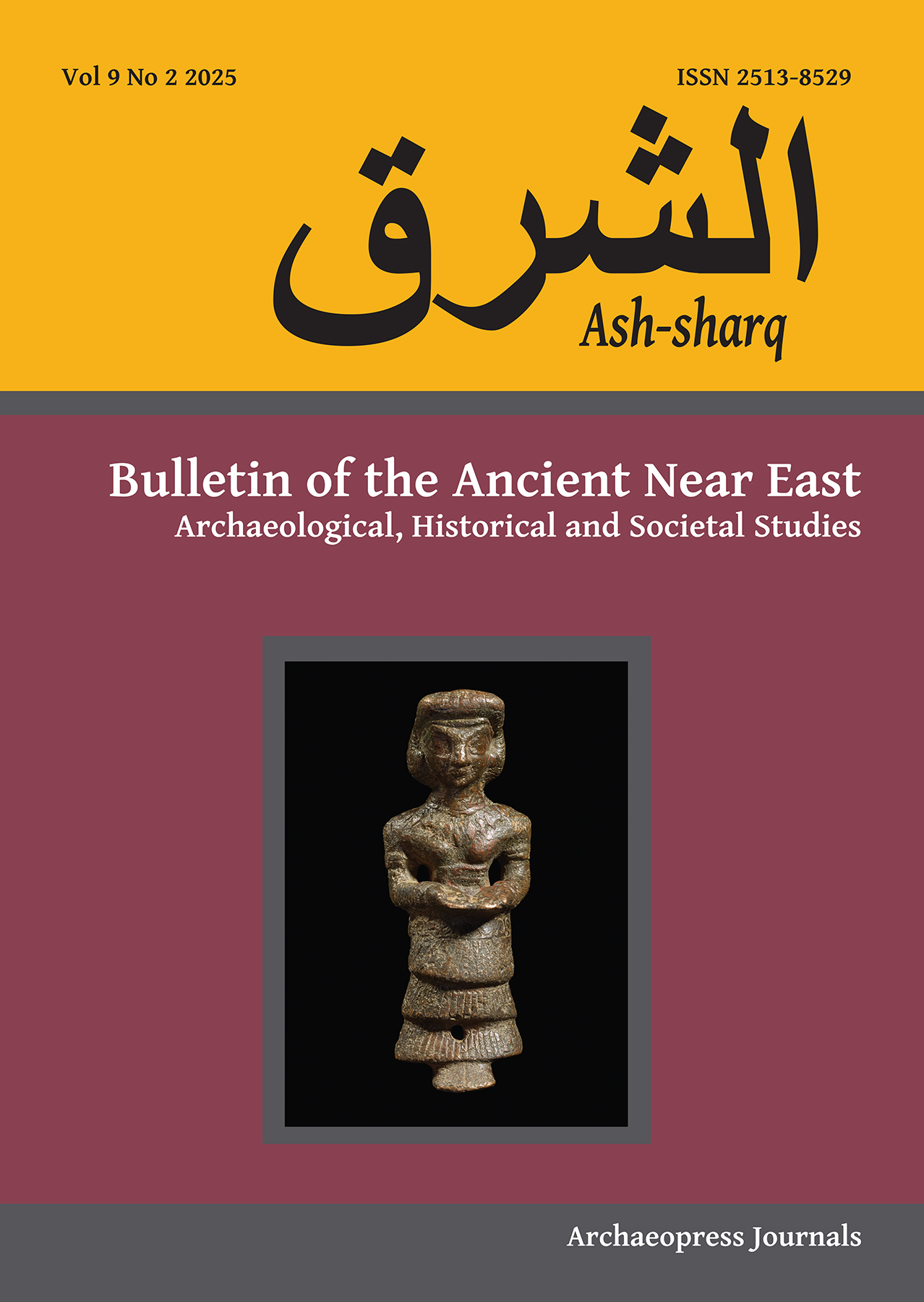
Exit ‘Presentation Scene’, Fiat ‘Temple Entrance Scene’. How to Rethink this Emblematic Scene of the First Half of the Second Millennium BC in Light of Textual Records and the Theory of Emotions
Keywords:
‘presentation scene’ seals, Third Dynasty of Ur, Old Babylonian period, statues, emotions, location of statuesAbstract
Can the seals from the third dynasty of Ur and Old Babylonian periods called ‘presentation scene’ seals be analyzed in a new way? And what do these seals mean? This article tries to answer these questions, starting from a detail of the seals’ iconography, the royal inscriptions and the theory of emotions.
References
Al-Gailani Werr, L. 1988. Studies in the Chronology and Regional Style of Old Babylonian Cylinder Seals (Bibliotheca Mesopotamica 23). Malibu: Undena Publications.
Battini 2002. De l’étude des sceaux: quelques nouvelles pistes en partant de l’analyse du sceau A 27902 de l’Oriental Institute Museum de Chicago. Akkadica 123: 153–161.
Battini 2006. Les sceaux Parrot GM 29 et 39: regards sur le scorpion. Mesopotamia XLI : 1–12.
Battini 2022. Corps ou persona ? L’enfant à l’époque néo-assyrienne, in L. Battini (ed.) Image and Identity in the Ancient Near East. Papers in memoriam Pierre Amiet (AANEA 8): 11–26. Oxford: Archaeopress.
Battini, L. 2025. Les statues qui un temps étaient : catalogue imaginaire des statues perdues ou comment repenser la scène de présentation de la glyptique, la production coroplastique et la sculpture mésopotamienne, in N. Delfèrriere and E. Retournard (eds) De l’Orient ancien à la Gaule Romaine, sans jamais perdre le fils. Recherches étoffes offertes à Catherine Breniquet (Monographies Instrumentum 81): 441–464. Drémil-Lafage: Ed. Mergoil.
Bertelli, S. and M. Centanni (eds) 1995. Il gesto nel rito e nel cerimoniale dal mondo antico ad oggi. Firenze: Ponte alle Grazie.
Buchanan, B. 1981. Early Near Eastern Seals in the Yale Babylonian Collection. New Haven/London: Yale University Press.
Burnett, D., E. Bleibtreu and G. Turner 1998. Sculptures from the Southwest Palace of Sennacherib at Nineveh. London: British Museum.
Campe, R. and J. Weber 2014. Rethinking Emotion: Interiority and Exteriority in Premodern, Modern and Contemporary Thought. Berlin/Boston: de Gruyter.
Collon, D. 1982. Catalogue of Western Asiatic Seals in the British Museum. Cylinder Seals II: Akkadian, Post-Akkadian, Ur III Periods. London: British Museum Publications.
Collon, D. 1995. Filling motifs, in U. Finkbeiner et alii (eds) Beiträge zur Kulturgeschichte Vorderasiens. Festschrift für Rainer Michael Boehmer: 69-76. Main am Rhein: Ph. Von Zabern.
Dahl, J.L. 2024. Where have all the Ur III seals gone? AVAR 3 (2): 195–256.
Dick, M. 2005. The Mesopotamian cult statue: A sacramental encounter with divinity, in N.H. Walls (ed.) Cult Image and Divine Representation in the Ancient Near East (American Schools of Oriental Research Book Series 10): 43–67. Boston: ASOR.
Doumet, C. 1992. Sceaux et cylindres orientaux: la collection Chiha (Orbis biblicus et Orientalis, Archaeologica 9). Fribourg/Göttingen: Fribourg Academic Press/ Vandenhoeck Ruprecht.
Fischer, C. 1997. Siegelabrollungen im British Museum auf Ur III- zeitlichen Texten aus der Provinz Lagash. Unterssuchung zu den Verehrungsszenen. Baghdader Mitteilungen 28: 96–183.
Franke, J.A. 1977. Presentation seals of the Ur III/Isin Larsa period, in McG. Gibson and R. D. Biggs (eds) Seals and Sealings in the Ancient Near East (Bibliotheca Mesopotamica 6). Malibu: Undena Publications.
Frayne, D. 1997. Ur III period, 2112-2004 BC (The Royal inscriptions of Mesopotamia Early periods). Toronto: University of Toronto Press.
Gruber, M. 1980. Aspects of Nonverbal Communication in the Ancient Near East. Rome: Biblical Institute Press.
Haussperger, M. 1991. Die Einführungsszene. Entwicklung eines mesopotamischen Motivs von der altakkadischen bis zum Ende der altbabylonischen Zeit. München: Profil Verlag.
Horsnell, M.J.A. 1999. The Year-Names of the First Dynasty of Babylon. Volume II. The Year- Names Reconstructed and Critically Annotated in the Light of Their Exemplars. Hamilton: McMaster University Press.
Legrain, L. 1951. Ur Excavations X. Seal Cylinders. London/Philadelphia: The Trustees of the British Museum and the Museum of the University of Pennsylvania.
Marienberg, S. (ed.) 2017. Symbolic Articulation: Image, Word, and Body Between Action and Schema (Image World Action 4). Berlin/Boston: De Gruyter.
Mayr, R. 1995. Compte rendu de M. Haussperger Die Einführungsszene: Entwicklung eines mesopotamischen Motivs. Bibliotheca Orientalis 52: 460–464.
Mayr, R. 2011. The figure of the worshiper in the presentation scene, in D.I. Owen (ed.) Garshana Studies: 1–5. Bethesda: CDL Press.
Michalowski, P. 2008. The mortal kings of Ur: A short century of divine rule in ancient Mesopotamia, in N. Brisch (ed.) Religion and Power: Divine Kingship in the Ancient World and Beyond (Oriental Institute Seminars 4): 33–45. Chicago: The University of Chicago Press.
Morandi, D. 1988. Stele e statue reali assire: localizzazione, diffusione e implicazione ideologiche. Mesopotamia 23: 143–150.
Porada, E. 1948. Mesopotamian Art in Cylinder Seals of the Pierpont Morgan Library. New York: Pierpont Morgan Library.
Suter, C. 2010. Ur III kings in images: A reappraisal, in H.D. Baker, E. Robson and G. Zólyomi (eds) Your Praise is Sweet. A Memorial Volume for Jeremy Black from Students, Colleagues and Friends: 319–349. London: British Institute for the Study of Iraq.
Winter, I.J. 1986. The king and the cup: Iconography of the royal presentation scene on Ur III seals, in M.K. Buccellati et alii (eds) Insight through Images: Studies in Honor of Edith Porada: 253–267. Malibu: Undena Publications.
Winter, I.J. 2010. ‘Idols of the king’: Royal images as recipients of ritual action in Ancient Mesopotamia, in I.J. Winter On Art in the Ancient Near East. Volume II: From the Third Millennium B.C.E. (Culture and History of the Ancient Near East Volume 34.2): 167–196. London/Boston: Brill.
Zajdowski, J. 2013. Transformation of the Mesopotamian banquet scene into the presentation scene in the Early Dynastic, Akkadian and Ur III Periods. Akkadica 134 (1): 1–16.