Bronze Age burial practices at the oasis of Taymāʾ, north-west Arabia: archaeology, bioanthropology, chronology
Keywords:
Taymāʾ, Bronze Age, burial practices, bioanthropology, chronologyAbstract
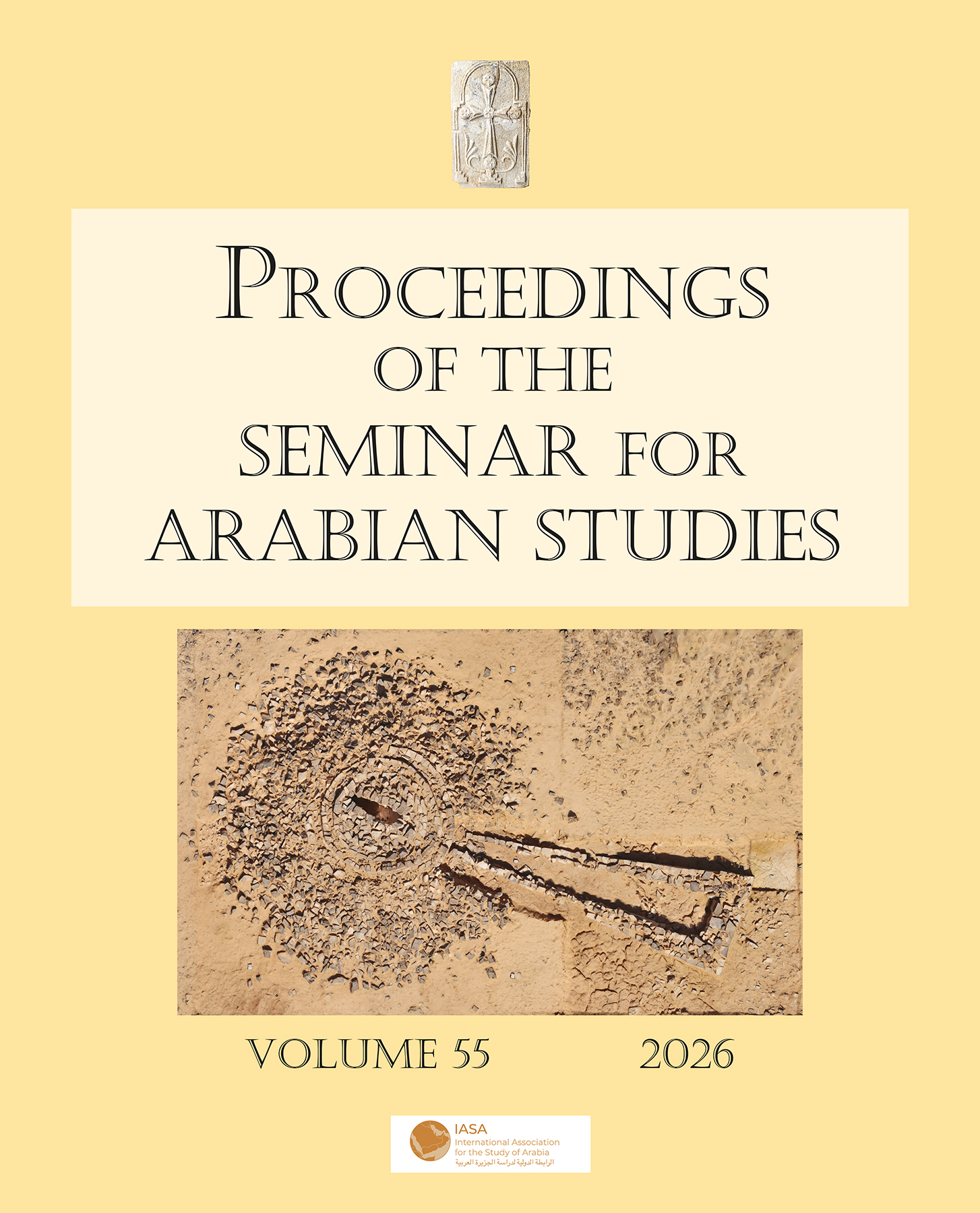
Bioanthropological and archaeological investigations in Rujum Saʿsaʿ, located south of the oasis of Taymāʾ, Saudi Arabia, examined the remains of fifty-four individuals from nineteen stone-built graves. While architectural features and associated finds have been used for establishing a general archaeological chronology for the graves, a new series of systematically obtained radiocarbon dates on bone bioapatite refines the occupational history of these graves. The dates demonstrate that the cemetery was used continuously from the late Early Bronze Age (twenty-third century cal BC) to the Middle Bronze Age and into the early Late Bronze Age (twelfth century cal BC). They further reveal repeated, sequential burial episodes within several tombs and provide the first opportunity to integrate chronological, bioanthropological, and archaeological evidence to investigate the spatial organization and development of funerary practices at Rujum Saʿsaʿ.
References
Abu-Azizeh W. 2015. Excavation of a cairn complex in Jabal al-Khraymât, Massif 22, loci 42000. Pages 172–192 in L. Nehmé, W. Abu-Azizeh, T. Bauzou, C. Durand, J. Rohmer, I. As-Sabban … F. Villeneuve (eds), Report on the fifth season (2014) of the Madâ’in Sâlih Achaeological Project. https://shs.hal.science/ halshs-01122002
Abu Duruk H.I. 1989. A preliminary report on the Industrial Site excavation at Tayma, first season 1408 AH/1987 AD. ATLAL – Journal of Saudi Arabian Archaeology 12: 9–19.
Abu Duruk H.I. 1990. A preliminary report on the Industrial Site excavation at Tayma, second season 1410 AH/1989 AD. ATLAL – Journal of Saudi Arabian Archaeology 13: 9–19.
Abu Duruk H.I. 1996. A preliminary report on the industrial site excavation at Tayma, third season 1411AH/1990 AD. ATLAL – Journal of Saudi Arabian Archaeology 14: 11–24.
Acsádi G. & Nemeskéri J. 1970. History of human life span and mortality. Budapest: Akadémiai Kiadó.
Alonazi M.T. 2018. A re-evaluation of stratigraphic and ceramic evidence from the Bronze and Iron Age site of al-Ṣināʿiyyah at Tayma in Saudi Arabia. PhD thesis, University of Durham. Available at https://etheses.dur.ac.uk/12809/
Alqahtani S.J., Hector M.P. & Liversidge H.M. 2010. Brief communication: The London atlas of human tooth development and eruption. American Journal of Physical Anthropology 142: 481–490.
Bass W.M. 1971. Human osteology: A laboratory and field manual of the human skeleton. (Missouri Archaeological Society, Special Publication no. 2). Columbia, MO: Missouri Archaeological Society.
Bawden G., Edens C. & Miller R. 1980. Preliminary archaeological investigations at Tayma. ATLAL – Journal of Saudi Arabian Archaeology 4: 69–106.
Boulestin B. & Courtaud P. 2022. Words between two worlds. Collective graves and related issues in burial terminology. Pages 55–68 in C.J. Knüsel & E.M.J. Schotsmans (eds), The Routledge handbook of archaeothanatology. Bioarchaeology of mortuary behaviour. Abingdon: Routledge.
Boulestin B. & Duday H. 2006. Ethnology and archaeology of death: from the illusion of references to the use of a terminology. Archaeologia Polona 44: 149–169.
Buikstra J.E. 2019. Ortner’s identification of pathological conditions in human skeletal remains. London: Academic Press.
Buikstra J.E. & Ubelaker D.H. 1994. Standards for data collection from human skeletal remains: Proceedings of a Seminar at the Field Museum of Natural History. Fayetteville, AR: Arkansas Archaeological Survey Press.
Calce E.S. 2012. A new method to estimate adult ageat‐death using the acetabulum. American Journal of Physical Anthropology 148: 11–23.
Chahoud J. 2014–2015. Animal offerings in funeral rites during the Bronze Age of Lebanon — L’aspect archéozoologique des pratiques funéraires à l’âge du bronze au Liban. Archaeology & History in the Lebanon 40–41: 74–90.
Charloux G., Cristofoli F., Creissen T., Alonazi M., Darchambeau A., Prioletta A. … Wadel A. 2023. The protohistoric and antique landscape of Qaryat al-Faw. The Saudi Heritage Commission Archaeological Mapping Project (2021–2022). Proceedings of the Seminar for Arabian Studies 52: 45–69.
Cherkinsky A., Prasad G.V.R., Pan H. & Sheng H. 2023. AMS 14C dating of bioapatite: Advantage and disadvantage. Nuclear Instruments and Methods in Physics Research Section B: Beam Interactions with Materials and Atoms 537: 77–80.
Cunningham C., Scheuer L. & Black S. 2017. Developmental juvenile osteology. London: Academic Press.
Dalton M., McMahon J., Kennedy M.A., Repper R., Al Shilali S.E., AlBalawi Y., Boyer D.D. & Thomas H. 2022. The Middle Holocene ‘funerary avenues’ of north-west Arabia. The Holocene 32/3: 183–199.
Duday H., Cipriani A.M. & Pearce J. 2009. The archaeology of the dead: Lectures in archaeothanatology. Oxford: Oxbow Books.
Eichmann R., Schaudig A. & Hausleiter A. 2006. Archaeology and epigraphy at Tayma, Saudi Arabia. Arabian Archaeology and Epigraphy 17: 163–176.
Eskoubi Kh., al-Utaibi S., al-Hanou A., al-Halawi M., Al-Hazazai Y. & al-Sawali M. 2019. Salvage excavations of two tells in Hai Naseem, Tayma. ATLAL – Journal of Saudi Arabian Archaeology 27: 101–105.
Fujii S. 2018. Bridging the enclosure and the tower tomb: New insights from the Wādī Sharmā sites, north-west Arabia. Proceedings of the Seminar for Arabian Studies 48: 83–99.
Goodman H.A. & Martin L.D. 2002. Reconstructing health profiles from skeletal remains. Pages 11–60 in R.H. Steckel & J.C. Rose (eds), The backbone of history. Health and nutrition in the Western Hemisphere. Cambridge: Cambridge University Press.
Gorman J., Roberts A.C., Newsham S. & Bentley R.G. 2022. Squatting, pelvic morphology and a reconsideration of childbirth difficulties. Evolution, Medicine, and Public Health 10: 243–255.
Al-Hajri M. 2002. Tayma excavations, Rujoum Sasa, first season 1418. ATLAL – Journal of Saudi Arabian Archaeology 17: 23–25.
Al-Hajri M. 2006. Brief report on the excavations at the Industrial Site in Tayma. ATLAL – Journal of Saudi Arabian Archaeology 19: 21–26.
Al-Hajri M. 2011. Syro-Levantine bronze weapons from Tayma’. Page 112 in U. Franke & J. Gierlichs (eds), Roads of Arabia – The archaeological treasures of Saudi Arabia. Berlin: Wasmuth.
Al-Hajri M. 2019. Syro-Levantine bronze weapons from Tayma’. Pages 82–83 in A. Capodiferro & S. Colantonio (eds), Roads of Arabia – Archaeological treasures from Saudi Arabia. Milan: Electa.
Al-Hajri M., al-Mutlaq M., Hashim A., al-Shama’n S., al-Najam S.F., al-Helwa S. & al-Radhiyan S. 2005. Archaeological excavations at the site of Rujoum Saʿsaʿ, Tayma. ATLAL – Journal of Saudi Arabian Archaeology 18: 23–27.
Hausleiter A. 2015. Tayma, Saudi-Arabien. Rettungsgrabungen im Gräberfeld von al-Nasim. Die Arbeiten des Jahres 2014. e-Forschungsberichte des DAI, 2015-2: 74–76.
Hausleiter A. 2017. Tayma, Saudi-Arabien. Survey im Gräberfeld von Rujum Sa‘sa‘. Die Arbeiten des Jahres 2016. e-Forschungsberichte des DAI, 2017-1: 105–113.
Hausleiter A. 2018. The outer wall of Taymāʾ and its dating to the Bronze Age. Pages 361–391 in L. Nehmé & A. Al-Jallad (eds), To the Madbar and back again. Studies in the languages, archaeology, and cultures of Arabia dedicated to Michael C.A. Macdonald. (Studies in Semitic Languages and Linguistics, 92). Leiden/Cologne: Brill.
Hausleiter A. 2019. The oasis of Tayma: 7000 years of history. Pages 107–131 in A. Capodiferro & S. Colantonio (eds), Roads of Arabia – Archaeological treasures from Saudi Arabia. Milan: Electa.
Hausleiter A. 2021. Mesopotamia and Arabia before King Nabonidus – An Old Babylonian cylinder seal from Taymāʾ, northwest Arabia. Pages 245–266 in M. Herles, C. Beuger, J. Becker & S. Arnhold (eds), Von Syrien nach Georgien – durch die Steppen Vorderasiens. Festschrift für Felix Blocher anlässlich seines 65. Geburtstags. (marru 13). Münster: Zaphon.
Hausleiter A. 2022. Tayma, Saudi-Arabien. Funeräre Landschaften, Kontakte und Mobilität in der Bronzezeit Nordwestarabiens (3.-2. Jt. v. Chr.). Die Arbeiten des Jahres 2020. e-Forschungsberichte des DAI, 2022-1: 103–110. doi.org/10.34780/5gu2-aagb
Hausleiter A. 2023. Tayma, Saudi-Arabien. Funeräre Landschaften, Kontakte und Mobilität in der Bronzezeit Nordwestarabiens (3.–2. Jt. v. Chr.). Die Arbeiten des Jahres 2021. e-Forschungsberichte des DAI, 2023-1: 74–83. doi.org/10.34780/3uea-e1bm
Hausleiter A. & Eichmann R. 2018. The archaeological exploration of the oasis of Taymāʾ. Pages 2–58 in A. Hausleiter, R. Eichmann & M. al-Najem (eds), Taymāʾ I – Archaeological exploration, palaeoenvironment, cultural contacts. Oxford: Archaeopress.
Hausleiter A. & Zur A. 2016. Tayma’ in the Bronze Age (c. 2,000 BCE): Settlement and funerary landscapes. Pages 135–173 in M. Luciani (ed.), The archaeology of North Arabia: Oases and landscapes, Proceedings of the International Congress, Vienna, 5–8 December, 2013. (Oriental and European Archaeology, 4). Vienna: Austrian Academy of Sciences.
Hausleiter A. & Zur A. 2019. The architecture of built graves at the oasis of Tayma during the Bronze Age: Summary of the current state of research. Pages 215–229 in S. Nakamura, T. Adachi & M. Abe (eds), Decades in the desert: Essays on Near Eastern archaeology in honour of Sumio Fujii. Tokyo: Rokuichi Syobou.
Hausleiter A., D’Andrea M. & Zur A. in collaboration with M. al-Hajri. 2018. The transition from Early to Middle Bronze Age in northwest Arabia: Bronze weapons from burial contexts at Tayma, Arabia and comparative evidence from the Levant. Zeitschrift für Orient-Archäologie 11: 412–436.
Herrmann B., Grupe G., Hummel S., Piepenbrink H. & Schutkowski H. 1990. Prähistorische Anthropologie: Leitfaden der Feld- und Labormethoden. Berlin/New York: Springer.
Höppner B., Lockhoff N. & Pernicka E. 2011. Chemische und bleiisotopische Zusammensetzung von zwei Metallobjekten aus Tayma. no. 11-068, Curt-Engelhorn-Zentrum, Mannheim. [Unpublished report].
İşcan M.Y., Loth S.R. & Wright R.K. 1984. Age estimation from the rib by phase analysis: White males. Journal of Forensic Sciences 29: 1094–1104.
İşcan M.Y., Loth S.R. & Wright R.K. 1985. Age estimation from the rib by phase analysis: White males. Journal of Forensic Sciences 30: 853–863.
Jaussen A. & Savignac R. 1914. Mission archéologique en Arabie II (texte et atlas). Paris: Paul Geuthner.
Konigsberg L.W. & Adams B. 2014. Estimating the number of individuals represented by commingled human remains: A critical evaluation of methods. Pages 193–220 in B.J. Adams & J.E. Byrd (eds), Commingled human remains: Methods in recovery, analysis, and identification. London: Academic Press.
Kremmer A., Steige L., Timm M., Zur A. & Hausleiter A. 2026. Reconstructing social practices from 3rd to 2nd millennium BCE burials in the north-western Arabian Peninsula. Studi Micenei ed Egeo-Anatolici Nova Series 12: 159–175.
Kriletić B., Vuković M. & Carić M. 2021. A case of bipartite patella and vastus notch from Kneževići hillfort – Malo Libinje, Croatia. Journal of Bioanthropology 1: 81–92.
Larsen C.S. 2015. Bioarchaeology: Interpreting behavior from the human skeleton. Cambridge: Cambridge University Press.
Laursen S.T. & al-Otaibi F. 2023. From Dilmun to Wādī al-Faw: A forgotten desert corridor c. 2000 BC. Arabian Archaeology and Epigraphy 34: 63–86.
Lora S., Petiti E. & Hausleiter A. 2010. Burial contexts at Tayma, NW Arabia: Archaeological and anthropological data. Pages 237–248 in L. Weeks (ed.), Death and burial in Arabia and beyond multidisciplinary perspectives. (British Archaeological Reports, 2107). Oxford: Archaeopress.
Lovejoy C.O., Meindl R.S., Pryzbeck T.R. & Mensforth R.P. 1985. Chronological metamorphosis of the auricular surface of the ilium: A new method for the determination of adult skeletal age at death. American Journal of Physical Anthropology 68: 15–28.
Lovell C.N. 2008. Analysis and interpretation of skeletal trauma. Pages 341–386 in M.A. Katzenberg & S.R. Saunders (eds), Biological anthropology of the human skeleton. Hoboken, NJ: Wiley.
Luciani M., Binder M. & Alsaud A. 2018. Life and living conditions in north-west Arabia during the Bronze Age: First results from the bioarchaeological work at Qurayyah. Proceedings of the Seminar for Arabian Studies 48: 185–200.
McKinley J.I. 2004. Compiling a skeletal inventory: Cremated human bone. Pages 9–13 in M. Brickley & J.I. McKinley (eds), Guidelines to the standards for recording human remains. Reading/Southampton: Institute of Field Archaeologists, BABAO.
Masry A. 1977. The historic legacy of Saudi Arabia. ATLAL – Journal of Saudi Arabian Archaeology 1: 9–19.
Meindl R.S. & Lovejoy C.O. 1985. Ectocranial suture closure: A revised method for the determination of skeletal age at death based on the lateral-anterior sutures. American Journal of Physical Anthropology 68: 57–66.
Munoz O. & Seguin G. 2023. Ras Al-Hadd HD-7.3 necropolis, Ash-Sharqiyah, Oman. Pages 34–39 in K.D. Williams (ed.), Landscapes of death. Early Bronze Age tombs and mortuary rituals on the Oman peninsula. Muscat: Ministry of Heritage and Tourism.
Munoz O., Ghazal R.O. & Guy H. 2012. Use of ossuary pits during the Umm an Nar period: New insights on the complexity of burial practices from the site of Ra’s al-Jinz (RJ-1), Oman. Pages 451–467 in J. Giraud & G. Gernez (eds), Aux marges de l’archéologie. Hommage à Serge Cleuziou. (Travaux de la maison René Ginouvès, 16). Paris: de Boccard.
Munoz O., Cotty M., Charloux G., Bouchaud C., Monchot H., Marquaire C. … Al-Malki T. 2020. Marking the sacral landscape of a north Arabian oasis: A sixthmillennium BC monumental stone platform and surrounding burials. Antiquity 94/375: 601–621.
Murail P., Bruzek J., Houët F. & Cunha E. 2005. DSP: A tool for probabilistic sex diagnosis using worldwide variability in hip-bone measurements. Bulletins et mémoires de la société d’anthropologie de Paris 17: 167–176.
Petiti E., Intilia A. & Hausleiter A. 2014. Bioarchaeological investigations at a 4th–3rd century BC cemetery at Tayma, north-west Arabia. Pages 373–392 in P. Bieliński, M. Gawlikowski, R. Koliński, D. Ławecka, A. Sołtysiak & Z. Wygnańska (eds), Proceedings of the 8th International Congress on the archaeology of the Ancient Near East, Warsaw, 30 April–4 May 2012. iii. Wiesbaden: Harrassowitz.
Phenice T.W. 1969. A newly developed visual method of sexing the os pubis. American Journal of Physical Anthropology 30: 297–301.
Poulmarc’h M., Bec Drelon N., Shabo S., Charloux G., AlMushawh M. & Crassard R. 2026. Bronze Age funerary practices in the Khaybar oasis, northwest Arabia. Archaeological and Anthropological Sciences 18: 109.
Rivière J. & Sévin-Allouet C. 2022. Animal deposits in the tombs of the Khor Jarama necropolis (Oman – 3500–2900 cal. BC). Poster presented at the ICAZASWA 15th International meeting, Nov. 2022. Tobunken (Japan). Available at https://hal.science/hal-03901264v1
Schaeffer M., Black S. & Scheuer L. 2009. Juvenile osteology:A laboratory and field manual. London: Academic Press.
Scheuer L. & Black S. 2000. Developmental juvenile osteology. London: Academic Press.
Schmitt A. & Déderix S. 2018. What defines a collective grave? Archaeological and ethnological perspectives on collective burial practices. Pages 195–213 in A. Schmitt, S. Déderix & I. Crevecoeur (eds), Gathered in death. Archaeological and ethnological perspectives on collective burial and social organisation. Louvain-la-Neuve: Presses universitaires de Louvain.
Senol R.G.T & Yücel A.H. 2019. Evaluation and categorization of femur morphometry with digital measurement method. Journal of Evolution of Medical and Dental Sciences 8: 3064–3069.
Smith H.B. 1984. Patterns of molar wear in huntergatherers and agriculturalists. American Journal of Physical Anthropology 63: 39–56.
Steckel R.H., Larsen C.S., Sciulli P.W. & Walker P.L. 2018. Data collection codebook. The backbone of Europe health, diet, work and violence over two millennia. Cambridge: Cambridge University Press.
Stloukal M. & Hanaková H. 1978. Die Länge der Langknochen altslawischer Bevölkerungen unter besonderer Berücksichtigung von Wachstumsfragen. Homo. Journal of Comparative Human Biology 29: 53–69.
Al-Taimā’ī M.H.S. 2006. Mintiqat rujum saʿsaʿ bi-taymāʾ – dirasat al-madaniyyah. Riyadh: Ministry of Education.
Thomas H., MacMahon J., Swift L., Franklin D., Bagdadi F., Alagich R. & Kennedy M. 2025. The Bronze Age tombs of northwest Arabia: A chrono-typological study from AlUla and Khaybar, Saudi Arabia. Arabian Archaeology and Epigraphy 36: 52–69.
Todd T.W. 1920. Age changes in the pubic bone. I. The male white pubis. American Journal of Physical Anthropology 3/3: 285–334.
Tourtet F., Daszkiewicz M. & Hausleiter A. 2021. Pottery from Tayma: Chronostratigraphy, archaeometry, cultural interaction. Pages 43–88 in M. Luciani (ed.), The archaeology of the Arabian Peninsula 2 – Connecting the evidence. Proceedings of the workshop at the 10th International Congress on the archaeology of the Ancient Near East, Vienna, 2016. (Oriental and European Archaeology, 19). Vienna: Austrian Academy of Sciences.
Ubelaker D.H. 1978. Human skeletal remains. Excavation, analysis, interpretation. Chicago: Aldine Publishing Company.
White T.D., Black M.T. & Folkens P.A. 2012. Human osteology. London: Academic Press.
Williams K.D. 2023. Landscapes of death. Early Bronze Age tombs and mortuary rituals on the Oman peninsula. Muscat: Ministry of Heritage and Tourism.
Zazzo A. 2014. Bone and enamel carbonate diagenesis: A radiocarbon prospective. Palaeogeography, Palaeoclimatology, Palaeoecology 416: 168–178.
Zazzo A. & Saliège J-F. 2011. Radiocarbon dating of biological apatites: A review. Palaeogeography, Palaeoclimatology, Palaeoecology 310: 52–61.
Zur A. (in preparation). Early to Middle Bronze Age burial customs of northwest Arabia. The funerary landscape of Tayma. PhD thesis, Freie Universität Berlin.
Zur A. & Hausleiter A. with a contribution by E. Petiti. 2018. Funerary landscapes in 2nd millennium BCE Tayma, northwest Arabia. Pages 355–367 in B. Horejs, Ch. Schwall, V. Müller, M. Luciani, M. Ritter, M. Guidetti … T. Bürge (eds), Proceedings of the 10th International Congress on the archaeology of the Ancient Near East, Vienna, 25–29 April 2016. i. Wiesbaden: Harrassowitz.
Published
How to Cite
Issue
Section
License
Archaeopress Publishing, Oxford, UK