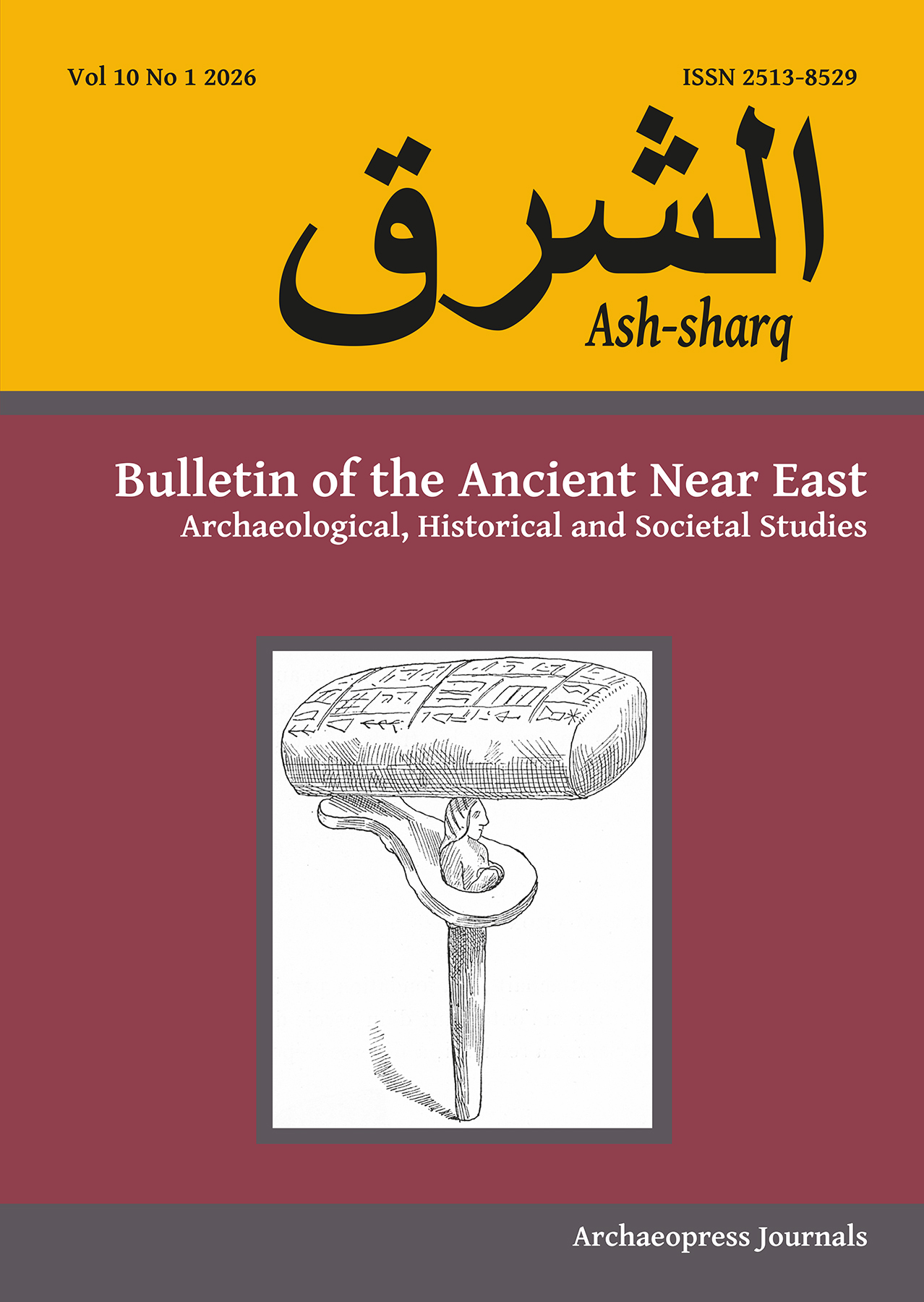
Coping with Decay: Understanding the Origin and Meaning of Foundation Deposits and Building Records in Ancient Mesopotamian Societies
Keywords:
Ancient Mesopotamia, DecayAbstract
From the middle of the 3rd millennium BC until late in the 1st millennium BC, Mesopotamian rulers followed the practice of depositing certain kinds of objects (often inscribed) in the foundations of their newly erected temples, palaces, and other official buildings. In addition, for over two millennia it was common to inscribe movable parts of buildings (e.g. bricks and door-sockets) with inscriptions of varying length reporting on the respective activities. This set of practices and the related material culture is unique to Mesopotamian societies since, to our knowledge, no other literate ancient society developed such a complex and long-lasting strategy for coping with the disadvantages posed by natural conditions for the construction and maintenance of the built environment.
Drawing on the Early Bronze Age evidence, this paper aims to investigate the origins of foundation deposits and building records in 3rd-millennium southern Mesopotamia by analyzing the meaning of these objects in light of the environmental conditions of building and the needs of human societies with regard to the built environment they created. Only by taking these two factors into consideration can we understand how and why foundation deposits and building records developed as essential components of related practices.
The insights gained through this analysis will lead to a reconceptualization of certain elements of foundation deposits, namely the so-called “foundation tablets,” and thereby to the resolution of research questions that have been discussed for decades, as will be demonstrated in two specific case studies.
References
Ambos, C. 2004. Mesopotamische Baurituale aus dem 1. Jahrtausend v. Chr. Dresden: ISLET.
Anastasio, S. 2011. Costruire tra i due fiumi: Introduzione all'edilizia in Mesopotamia tra Neolitico ed Età del ferro (Millenni 8). Firenze: Museo e Istituto fiorentino di preistoria "Paolo Graziosi".
Anastasio S. and P. Gilento 2020. Building Between the Two Rivers: An Introduction to the Building Archaeology of Ancient Mesopotamia. Oxford: Archaeopress.
Assmann, A. 2018. Erinnerungsräume: Formen und Wandlungen des kulturellen Gedächtnisses. 1st ed. München: C.H.Beck.
Assmann, J. 2003. Stein und Zeit: Mensch und Gesellschaft im alten Ägypten. München: Wilhelm Fink Verlag.
Averbeck, R.E. 2010. Temple Building among the Sumerians and Akkadians (Third Millennium), in M.J. Boda and J. Novotny (eds) From the Foundations to the Crenellations: Essays on Temple Building in the Ancient Near East and Hebrew Bible (Alter Orient und Altes Testament 366): 3–34. Münster: Ugarit-Verlag.
Bär, J. 2003. Die älteren Ischtar-Tempel in Assur: Stratigraphie, Architektur und Funde eines altorientalischen Heiligtums von der zweiten Hälfte des 3. Jahrtausends bis zur Mitte des 2. Jahrtausends v. Chr. (Wissenschaftliche Veröffentlichungen der Deutschen Orient- Gesellschaft 105). Saarbrücken: SDV, Saarbrücker Druckerei und Verlag.
Braun-Holzinger, E.A. 1999. Apotropaic figures at Mesopotamian temples in the third and second millennia, in T. Abusch and K. van der Toorn (eds) Mesopotamian Magic: Textual Historical and Interpretative Perspectives (Ancient magic and divination 1): 149–172. Groningen: STYX Publ.
Braun-Holzinger, E.A. 2007. Das Herrscherbild in Mesopotamien und Elam: Spätes 4. Bis frühes 2. Jt. v. Chr. (Alter Orient und Altes Testament 342). Münster: Ugarit.
Braun-Holzinger, E.A. 2013. Frühe Götterdarstellungen in Mesopotamien. 1st ed (Orbis biblicus et orientalis 261). Fribourg/ Göttingen: Fribourg Academic Press/ Vandenhoeck und Ruprecht.
Cluzan, S. and P. Butterlin (eds) 2014. Voués à Ishtar: Syrie, janvier 1934, André Parrot découvre Mari: Exposition au musée de l'Institut du monde arabe 23 janvier-4 mai 2014 (Guides archéologiques de l'Institut français du Proche-Orient no 11). Beyrouth: Institut Français du Proche-Orient.
Cohen, M.E. 1993. The Cultic Calendars of the Ancient Near East. Bethesda: CDL Press.
Cohen, M.E. 2015. Festivals and Calendars of the Ancient Near East. Bethesda: CDL Press.
Cooper, J.S. 1980. Studies in Mesopotamian lapidary inscriptions. II. Revue d'Assyriologie et d'archéologie orientale 74: 101–110.
Crawford, V.E. 1959. Nippur, the holy city. Archaeology 12: 74–83.
Cunningham, G. 1997. 'Deliver Me from Evil': Mesopotamian Incantations 2500 - 1500 BC. Zugl.: Cambridge, Univ. Diss. 1995 (Studia Pohl: Series Maior 17). Roma: Ed. Pontificio Istituto Biblico. de Sarzec, E. and L. Heuzey 1884-1912. Découvertes en Chaldée. Paris: E. Leroux.
Delougaz, P. 1933. Plano-Convex Bricks and the Methods of Their Employment (Studies in Ancient Oriental Civilization 7). Chicago: University of Chicago Press.
Delougaz, P. 1940. The Temple Oval at Khafājah (Oriental Institute publications 53). Chicago: The University of Chicago Press.
Delougaz P., H.D. Hill and S. Lloyd 1967. Private Houses and Graves in the Diyala Region (Oriental Institute publications 88). Chicago: The University of Chicago Press.
Delougaz, P. and S. Lloyd 1942. Pre-Sargonic Temples in the Diyala Region (Oriental Institute publications 58). Chicago: The University of Chicago Press.
Edzard, D.O. 1997. Gudea and His Dynasty (RIME 3/1). Toronto: University of Toronto Press.
Ellis, R. S. 1968. Foundation Deposits in Ancient Mesopotamia. London/New Haven: Yale University Press.
Evans, J. M. 2007. The Square temple at Tell Asmar and the construction of Early Dynastic Mesopotamia, ca. 2900-2350 B.C.E. American Journal of Archaeology 111: 599–632. https:// doi.org/ 10.2307/ 40025265.
Forest, J.-D. 1999. Les premiers temples de Mésopotamie: (4e et 3e millénaires) (British Archaeological Reports International series 765). Oxford: Archaeopress.
Frayne, D. 1993. Sargonic and Gutian Periods: (2334 - 2113 BC) (The Royal Inscriptions of Mesopotamia. Early Periods 2). Toronto: University of Toronto Press.
Frayne, D. 1997. Ur III Period: (2112-2004 BC) (The Royal Inscriptions of Mesopotamia. Early Periods 3/2). Toronto: University of Toronto Press.
Frayne, D.R. 2008. Presargonic Period (2700-2350 BC) (The Royal Inscriptions of Mesopotamia. Early Periods 1). Toronto: University of Toronto Press.
Grayson, A.K. 1987. Assyrian Rulers of the 3. and 2. Millennia BC. (The royal inscriptions of Mesopotamia. Assyrian periods 1). Toronto: University of Toronto Press.
Gries, H. 2017. Der Assur-Tempel in Assur: Das assyrische Hauptheiligtum im Wandel der Zeit (Wissenschaftliche Veröffentlichungen der Deutschen Orient-Gesellschaft 149). Wiesbaden: Harrassowitz Verlag.
Gruber, M. 2018. The topography of the temenos at Ur and its changes from the Third Dynasty to the Kassite period, in K. Kaniuth, D. Lau, and D. Wicke (eds) Übergangszeiten: Altorientalische Studien für Reinhard Dittmann anlässlich seines 65. Geburtstags (Marru 1): 171–193. Münster: Zaphon.
Flückiger-Hawker, E. 1999. Urnamma of Ur in Sumerian Literary Tradition (Orbis biblicus et orientalis 166). Firbourg/Göttingen: Fribourg Academic Press/ Vandenhoeck & Ruprecht.
Halbwachs, M. 1997. La mémoire collective (Bibliothèque de l'évolution de l'humanité). Paris: Michel.
Flückiger-Hawker, E. 2008. La topographie légendaire des évangiles en terre sainte: étude de mémoire collective. 1st ed. Quadrige. Paris: Presses Universitaires de France.
Haller, A. and W. Andrae 1955. Die Heiligtümer des Gottes Assur und der Sin-Šamaš-Tempel in Assur (Wissenschaftliche Veröffentlichungen der Deutschen Orient-Gesellschaft 67). Wiesbaden: Harrassowitz.
Hansen, D.P. 1970. Al-Hiba, 1968–1969, a preliminary report. Artibus Asiae 32: 243–258.
Heuzey, L. 1897. La construction du roi Our-Nina: d'après les levés et les notes de M. de Sarzec. Revue d'Assyriologie et d'archéologie orientale 4 : 87–122.
Heuzey, L. 1899. Construction antérieure a Our-Nina. Revue d'Assyriologie et d'archéologie orientale 5: 33–56.
Heuzey, L. 1900. Une villa royale chaldéenne vers l'an 4000 avant notre âge d'après les levées et les notes de M. de Sarzec. Paris: Ernest Leroux.
Heuzey, L. 1902. Catalogue des antiquités chaldéennes: sculpture et gravure à la pointe. Paris: Librairies - Imprimeries Réunies.
Kaniuth K., A. Löhnert, J. Miller, A. Otto, M. Roaf and W. Sallaberger (eds) 2013. Tempel im Alten Orient: 7. internationales Colloquium der Deutschen Orient-Gesellschaft 11.-13. Oktober 2009 München (Deutsche Orient-Gesellschaft 7). Wiesbaden: Harrassowitz.
Kärger, B. 2021. Götter, Tempel, numinose Machtmittel …: Eine Untersuchung mythischer Hyleme und religiöser Vorstellungen in sumerischen Texten im Kontext eines Transfers aus dem Himmel, in G. Gabriel, B. Kärger, A. Zgoll, and C. Zgoll (eds) Was vom Himmel kommt: Stoffanalytische Zugänge zu antiken Mythen aus Mesopotamien, Ägypten, Griechenland und Rom: 55-160. Berlin/Boston: de Gruyter.
Klengel-Brandt, E. and D. Rittig 1982. Korbträgerfiguren aus Assur. Forschungen und Berichte 22: 97–114. https:// doi.org/ 10.2307/ 3880898.
Kraus, F.R. 1947. Altmesopotamische Tonnaegel mit Keilinschriften, in Halil Edhem hâtira kitabı / in memoriam Halil Edhem (Türk Tarih Kurumu yayınlarından VII, Seri No. 5): 71–113. Ankara: Türk Tarih Kurumu Basimevi.
Marchesi, G. and N. Marchetti 2011. Royal Statuary of Early Dynastic Mesopotamia (Mesopotamian Civilizations 14). Winona Lake: Eisenbrauns.
Margueron, J.-C. 2004. Mari: Métropole de l'Euphrate au IIIe et au début du IIe millénaire av.J.-C. Paris: Picard.
Miglus, P.A. 2017. Die Sakralarchitektur in Ur zur Kassitenzeit, in A. Bartelmus and K. Sternitzke (eds) Karduniaš: Babylonia under the Kassites: The Proceedings of the Symposium Held in Munich 30 June to 2 July 2011. Tagungsbericht des Münchner Symposiums vom 30. Juni bis 2. Juli 2011: 333–350. Boston/Berlin: de Gruyter.
Parrot, A. 1948. Tello: Vingt Campagnes de Fouilles (1847-1933). Paris: Michel.
Parrot, A. 1956. Le temple d'Ishtar (Bibliothèque archéologique et historique). Paris: Geuthner.
Radner, K. 2005. Die Macht des Namens: Altorientalische Strategien zur Selbsterhaltung. Teilw. zugl.: München Univ., Habil.-Schr. 2004. (SANTAG 8). Wiesbaden: Harrassowitz.
Rashid, S.A. 1965. Gründungsfiguren und Gründungsbeigaben: Ihr Ursprung, ihre Entwicklung und Bedeutung. Dissertation zur Erlangung des Doktorgrades, Universität Frankfurt.
Rashid, S.A. 1983. Gründungsfiguren im Iraq. Teilw. zugl.: Frankfurt a. M. Univ., Diss. 1965. Prähistorische Bronzefunde I/2. München: C. H. Beck.
Sallaberger, W. 2011–2013.Tempel A. I. a. Philologisch. in Mesopotamien, in Reallexikon der Assyriologie und Vorderasiatischen Archäologie Bd. 13: 519–524.
Sallaberger, W. 2015. Kulturelle Kohärenz durch Prestige: Die Feste der mesopotamischen Königsstadt Ur, in B. Backes and C. von Nicolai Kulturelle Kohärenz durch Prestige (Münchner Studien zur Alten Welt 10): 9–28. München: Utz, Herbert.
Sallaberger, W. and I. Schrakamp 2015. Philological data for a historical chronology of Mesopotamia in the 3rd millennium, in W. Sallaberger and I. Schrakamp (eds) History & Philology (Associated Regional Chronologies for the Ancient Near East and the Eastern Mediterranean 3): 1–136. Turnhout: Brepols.
Sauvage, M. 1998. La brique et sa mise en oeuvre en Mésopotamie: dès origines à l'époque achéménide. Paris: Éditions Recherche sur les Civilisations.
Schäfers, B. 2010. Architektursoziologie. Grundlagen – theoretische Ansätze – empirische Belege, in P. Trebsche, N. Müller-Scheeßel, and S. Reinhold (eds) Der gebaute Raum: Bausteine einer Architektursoziologie vormoderner Gesellschaften (Tübinger archäologische Taschenbücher 7): 29–40. Münster: Waxmann.
Schäfers, B. 2014. Architektursoziologie. 3rd ed. Wiesbaden: VS Verlag für Sozialwissenschaften.
Schaudig, H. 2003. Nabonid, der "Archäologe auf dem Königsthron". Erwägungen zum Geschichtsbild des ausgehenden neubabylonischen Reiches, in G.J. Selz (ed.) Festschrift für Burkhart Kienast: Zu seinem 70. Geburtstage dargebracht von Freunden, Schülern und Kollegen (Alter Orient und Altes Testament 274): 447–497. Münster: Ugarit-Verlag.
Schmitt, A.W. 2012. Die Jüngeren Ischtar-Tempel und der Nabû-Tempel in Assur: Architektur, Stratigraphie und Funde. mit interaktiven Architekturplänen und Fotos auf CD-ROM (Wissenschaftliche Veröffentlichungen der Deutschen Orient-Gesellschaft 137). Wiesbaden: Harrassowitz.
Schmitt, A.W. 2019. Hidden under the floors. The inventories and archives of the Ganunmḫ at Ur from the third to the first millennium BC, in J.M. Evans and E. Roßberger (eds) Ancient Near Eastern Temple Inventories in the Third and Second Millennia BCE: Integrating Archaeological, Textual, And Visual Sources: 83–106. Gladbeck: PeWe-Verlag.
Schmitt, A.W. 2020. Altorientalische Erinnerungskulturen: Eine Untersuchung zum Interesse an und dem Umgang mit Vergangenheit in altmesopotamischen Gesellschaften des 3. bis 1. Jts. v. Chr. basierend auf Fallstudien aus Assur und Ur ausgehend von der materiellen Kultur. Habilitationsschrift, Johannes Gutenberg- Universität Mainz.
Seeher, J. 2007. Die Lehmziegel-Mauer von Hattuša: Bericht über eine Rekonstruktion. Istanbul.
Suter, C.E. 2000. Gudea’s Temple Building. The Representation of an Early Mesopotamian Ruler in Text and Image (Cuneiform monographs 17). Groningen: STYX.
Tsouparopoulou, C. 2014. Hidden messages under the temple: foundation deposits and the restricted presence of writing in 3rd millennium BCE Mesopotamia, in T. Frese, W.E. Keil, and K. Krüger (eds) Verborgen, unsichtbar, unlesbar - zur Problematik restringierter Schriftpräsenz (Materiale Textkulturen 2): 17–31. Berlin: de Gruyter.
Tsouparopoulou, C. 2016. Deconstructing textuality, reconstructing materiality, in T.E. Balke and C. Tsouparopoulou (eds) Materiality of Writing in Early Mesopotamia (Materiale Textkulturen 13): 257–275. Berlin/Boston: De Gruyter.
van Buren, E.D. 1931. Foundation Figurines and Offerings. Berlin: H. Schoetz & Co. van Ess, M. and F. Tourtet 2014. Tonknauf, in Reallexikon der Assyriologie und Vorderasiatischen Archäologie Bd. 14: 93–96. Berlin/Boston: de Gruyter.
Walker, C. 2014. Tonnagel (beschriftet) (cone), in Reallexikon der Assyriologie und Vorderasiatischen Archäologie Bd. 14: 96–98. Berlin/Boston: de Gruyter.
Wilson, K.L. 2012. Bismaya Recovering the Lost City of Adab (Oriental Institute publications 138). Chicago: The University of Chicago Press.
Woolley, C.L. 1939. The Ziggurat and Its Surroundings (Ur Excavations 5). London: Trustees of the Two Museums.
Woolley, C.L. 1974. The Buildings of the Third Dynasty (Ur Excavations 6). London: Trustees of the British Museum.
Zettler, R.L. 1992. The Ur III Temple of Inanna at Nippur: The Operation and Organization of Urban Religious Institutions in Mesopotamia in the Late Third Millenium B.C. (Berliner Beiträge zum Vorderen Orient). Berlin: Reimer.