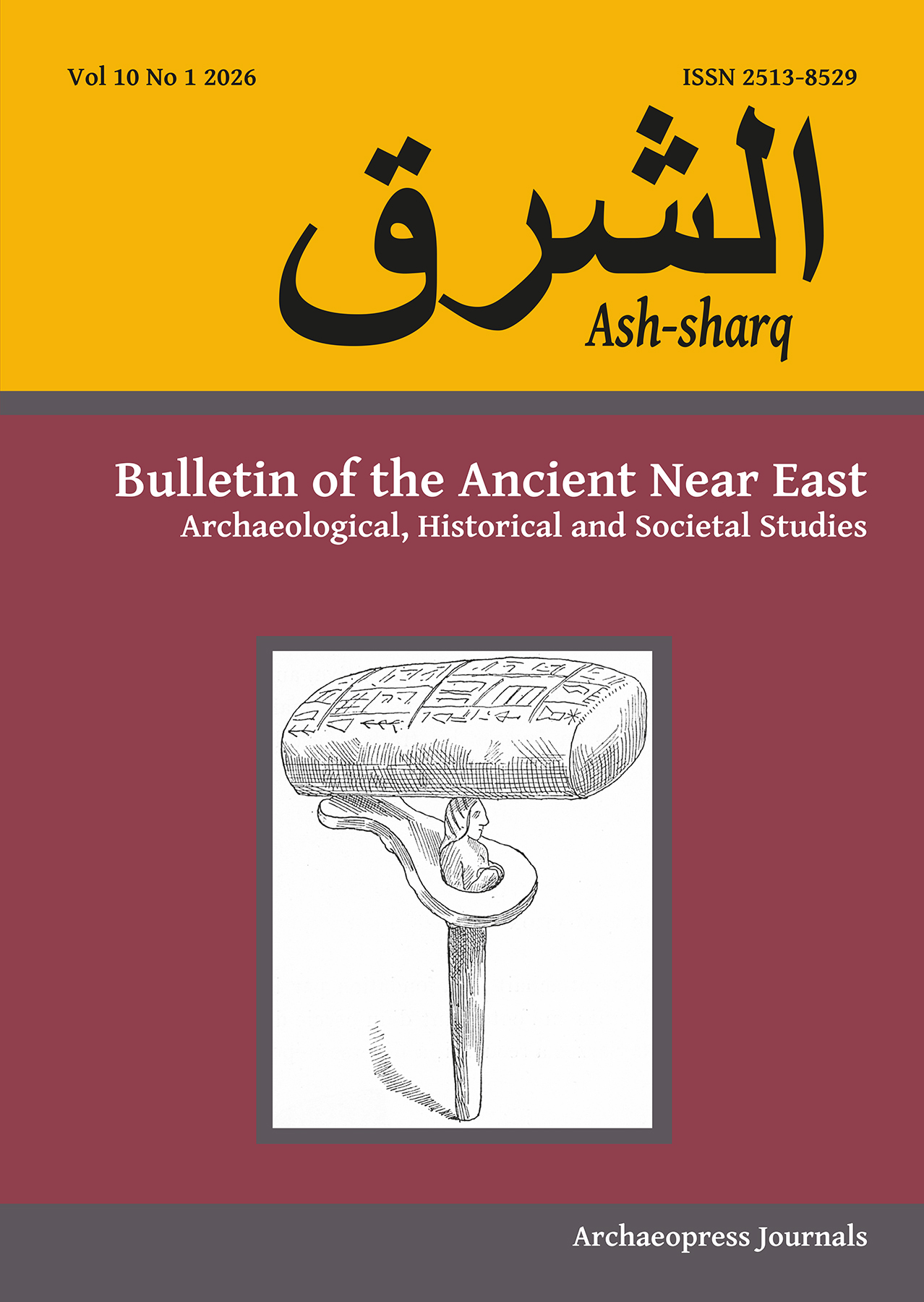
Jewellery Production and Metallurgical Connectivity on the Muş Plain: A Protohistoric Bivalve Stone Mould from Saint Karapet Monastery area
Keywords:
Early Bronze Age, Muş Plain, Kura-Araxes, Jewellery Mould, MetallurgyAbstract
This study presents a detailed analysis of a bivalve stone mould for jewellery production discovered near the monastery of Surb Karapet at Yukarıyongalı/Çengilli, on the Muş Plain in eastern Turkey. The findspot lies on a key east–west corridor linking the Lake Van basin to the Upper Euphrates and the Armenian Highland, an area known for its Early Bronze Age (EBA) participation in the Kura–Araxes cultural network. The finely carved steatite/serpentine mould bears multiple small matrices for geometric plaques and pendants, connected by a rational feed and vent system, with dowel holes for pin-alignment. Its technological and typological features closely match portable “trinket” moulds used across the Near East from the late 3rd to early 2nd millennium BCE, while also recalling Late Bronze Age analogues from the Levant. Comparative and contextual evidence, including EBA III metallurgical workshops at Murat Höyük (Bingöl), supports an attribution to the late EBA, though continuity of form and technique into the LBA remains plausible. The object thus offers new insight into early metallurgical connectivity and ornament production on the highland routes linking Eastern Anatolia with the Caucasus and northern Mesopotamia.
References
Areshian G. 2005. Early bronze age settlements in the Ararat plain and its vicinity. Archaeologische Mitteilungen aus Iran und Turan 37: 71–88.
Badalyan, R. 2014. New data on the periodization and chronology of the Kura-Araxes culture in Armenia. Paléorient 40(2): 71-92.
Bamyacı, A.O. and A. Özdemir 2022. Murat Höyük early bronze age stone moulds. Arkeoloji Dergisi 2(29): 1–16.
Biçer, K.K. 2005. Multifaceted Stone and Ceramic Moulds from Bronze Age Anatolia: Building An Analytical Protocol and Developing A Replication Approach. PhD thesis, Massachusetts Institute of Technology.
Biber, H. 2018. Muş İli Arkeolojik Yüzey Araştırmaları (2009–2014). İstanbul.
Bobokhyan A., K. Meliksetian, B. Gasparyan, P. Avetisyan, C. Chataigner and E. Pernicka 2014. Transition to extractive metallurgy and social transformation in Armenia at the end of the stone age, in B. Gasparyan and M. Arimura (eds) Stone Age of Armenia: 283–314. Kanazawa: Kanazawa University Press. Canby, J.V. 1965. Early Bronze ‘trinket’ moulds. Iraq 27: 42–61.
Durgun, P. 2012. Social Organization in the Early Bronze Age: Demircihöyük – A Re- Evaluation, unpublished MA thesis, Koç University.
Erdoğan, S., Çiftçi, Y. and Ercek, M. (eds) 2023. Tepeköy Höyük I: Erken Tunç Çağı. Ankara: Bilgin Kültür Sanat.
Gevorgyan, A., Danielyan, H., Hovsepyan, R., Vanyan, H., Manaseryan, N., Manoukian, N., Azizyan, A., and Bobokhyan, A.. 2021. Margahovit: Craft and subsistence economy in a Bronze/Iron Age community between the Pambak and Bazum Mountains, Armenia, in P. Avetisyan et A. Bobokhyan (eds) Archaeology of Armenia in Regional Context: 69-88. Yerevan: Publishing House of IAE.
Golani, A. 2019. Technological observations on two-part stone jewellery-casting molds of the Late Bronze Age in the Near East. Journal of Eastern Mediterranean Archaeology & Heritage Studies 7(1): 44–62.
Güder, Ü. and Özdemir, A. 2021. Early Bronze Age metallurgy at Murat Höyük, Eastern Anatolia: archaeometrical assessments of a figurine and a metal tool. TÜBA-KED Türkiye Bilimler Akademisi Kültür Envanteri Dergisi 24: 11–22.
Kılıç, S. 2023. Muş/Varto Tepeköy Höyük Erken Tunç Çağı depo buluntusu – Early Bronze Age hoard from Tepeköy Höyük in Muş/Varto, in S. Erdoğan, Y. Çiftçi and M. Ercek (eds.) Tepeköy Höyük I: 133–154. Ankara: Bilgin Kültür Sanat.
Laneri, N. 2002. The discovery of a funerary ritual: Inanna/Ishtar and her descent to the Nether World in Titriş Höyük, Turkey. East and West 52(1/4): 9–51. Louvre Collections (online). Moules à figurines, bijoux et amulettes (Akhisar– Thyateira), AO 26063; S 611; AO 1133; CCO A 1526. Department of Near Eastern Antiquities. https://colorsandstones.eu/2023/02/22/molds-matrixes-from-ugaritsyria/
Özdemir A., A.O. Bamyacı and E. Demir 2021. Erken Tunç Çağında Murat Höyük. Istanbul: Ege Yayınları.
Passerini A., E. Rova and E. Boaretto 2018. Chronology (and chronologies) of the Kura-Araxes culture in the Southern Caucasus: An integrative approach through Bayesian analysis. Origini 41(1): 81–138.
Paterakis, A.B. and S. Omura 2017. The influence of East and West on bronze objects found in Central Anatolia: small bronze finds from Kaman-Kalehöyük, in J.M. Daehner, K. Lapatin, and A. Spinelli (eds) Artistry in Bronze: The Greeks and Their Legacy (XIXth International Congress on Ancient Bronzes), The Hellenistic East: 175–182. Los Angeles: Getty Publications. https://www.getty.edu/publications/ artistryinbronze/the-hellenistic-east/21-paterakis/#fn:13
Rothman, M.S. and G. Kozbe 1997. Muş in the Early Bronze Age. Anatolian Studies 47: 105–126.
Simonyan, H.E. 2015. The archaeological site of Shengavit: An ancient town in the Armenian highland. Fundamental Armenology 1: 134–168
Simonyan, H. 2019. Cognitive links between mountains and lowlands: balance weights from the EBA site of Shengavit. Aramazd 13(2): 34–52.
Sinclair, T.A. 1987. Eastern Turkey: An Archaeological and Architectural Survey, Vol. I. London: Pindar Press.
The British Museum (online). Jewellery-mould, reg. N.1670/91904 (Neo-Assyrian; sandstone). https://www.bmimages.com/preview.asp?image=00032622001&itemf=0001&itemstep=1&itemw=4&itemx=7&utm
Thomas, A. (ed.) 2016. L’histoire commence en Mésopotamie. Catalogue d’exposition, Musée du Louvre-Lens, 2 novembre 2016 – 23 janvier 2017. Gand: Snoeck Publishers / Musée du Louvre-Lens.
Ünan, S. and N. Ünan 2020. Stone jewelry moulds from Seyitömer Höyük. Talanta LII: 37–53.
Yıldırım, S. and N. Alkan 2022. Recent finds from Tepeköy Höyük (Varto): New insights into the Early Bronze Age of Eastern Anatolia. Belleten 86(309): 733–760. Online resource: Colors and Stones 2023. Molds & Matrixes from Ugarit (Syria). Available at: https://colorsandstones.eu/2023/02/22/molds-matrixes-from-ugarit-syria/