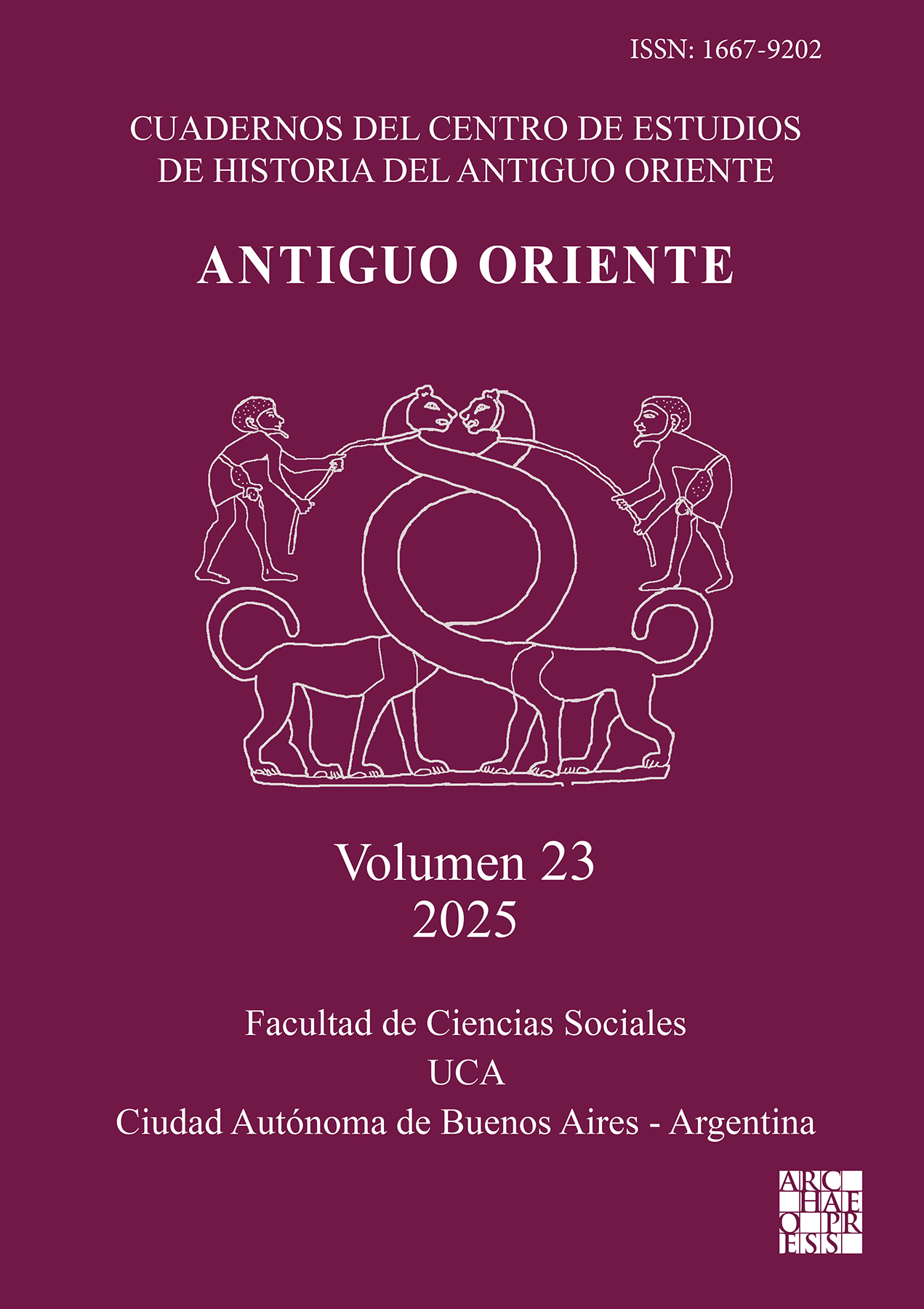
Laḫmu, el guardián divino de las puertas y guerrero: sobre el significado de lḥm en Deut 32:24 y Jue 5:8
DOI:
https://doi.org/10.32028/antor.v23i.3460Resumen
Este artículo sostiene que en Deut 32:24 y Jue 5:8 el término לחם (lḥm) puede interpretarse como una referencia al Laḫmu mesopotámico, una categoría de deidades menores que actuaban como guardianes de las puertas de los dioses superiores y que también cumplían funciones de guerreros divinos y espíritus protectores. Se argumenta que Deut 32:24 se refiere a Reshef y Qéteb como los “Laḫmus de Yahvé” (“mis Laḫmus”), en alusión a su papel como asistentes de Yahvé y agentes de castigo, mientras que Jue 5:8 se refiere a Débora como la “Laḫmu de las puertas”, destacando su función como guardiana y guerrera de su comunidad en tiempos difíciles y caóticos.
Citas
Abusch, T. 2016. The Magical Ceremony Maqlû: A Critical Edition. Ancient Magic and Divination 10. Leiden, Brill.
Andrae, W. 1938. Das wiedererstandene Assur. Leipzig, Hinrichs.
Annus, A. 2001. The Standard Babylonian Epic of Anzu: Introduction, Cuneiform Text, Transliteration, Score, Glossary, Indices and Sign List. State Archives of Assyria Cuneiform Texts 3. Helsinki, The Neo- Assyrian Text Corpus Project.
Archi, A. 2013. “The West Hurrian Pantheon and Its Background.” In: Collins, B.J. and Michalowski, P. (eds.), Beyond Hatti: A Tribute to Gary Beckman. Atlanta, Lockwood Press, 1-21.
Aruz, J. (ed.) 2003. Art of the First Cities: The Third Millennium BC from the Mediterranean to the Indus. New York, Yale University Press.
Barré, M.L. 1978. “dLAMMA and Rešep at Ugarit: The Hittite Connection.” In: Journal of the American Oriental Society 98, 465-467.
Beaulieu, P.A. 2011. “Yahwistic Names in Light of Late Babylonian Onomastics.” In: Lipschits, O., Knoppers, G. and Oeming, M. (eds.), Judah and the Judeans in the Achaemenid Period: Negotiating Identity in an International Context. Winona Lake, IN, Eisenbrauns, 245-266. Becking, B. 2023. Micah: A New Translation with Introduction and Commentary. New Haven, Yale University Press.
Black, J. and Green, A. 1998. Gods, Demons and Symbols of Ancient Mesopotamia: An Illustrated Dictionary. Second Edition. London, The British Museum Press.
Blair, J. 2009. De-Demonizing the Old Testament: An Investigation of Azazel, Lilith, Deber, Qeteb and Reshef in the Hebrew Bible. Forschungen zum Alten Testament II.37. Tübingen, Mohr Siebeck.
Bonatz, D. 2019. “Laḫmu, ‘The Hairy One’, and the Puzzling Issue of Mythology in Middle Assyrian Glyptic Art.” In: Avetisyan, P.S., Dan, R. and Grekyan, Y.H. (eds.), Over the Mountains and Far Away: Studies in Near Eastern History and Archaeology Presented to Mirjo Salvini on the Occasion of His 80th Birthday. Oxford, Archaeopress, 106-113.
Boston, J.R. 1967. The Song of Moses: Deuteronomy 32:1-43. Unpublished PhD Dissertation, Union Theological Seminary, New York.
Cathcart, K.J. 1977. “The ‘Demons’ in Judges 5.8a.” In: Biblische Notizen 21, 111-112.
Cooley, J.L. 2013. Poetic Astronomy in the Ancient Near East: The Reflexes of Celestial Science in Ancient Mesopotamian, Ugaritic, and Israelite Narrative. History, Archaeology, and Culture of the Levant. Winona Lake, IN, Eisenbrauns.
Craigie, P.C. 1972. “Some Further Notes on the Song of Deborah.” In: Vetus Testamentum 22, 349-353.
Cross, F.M. 1973. Canaanite Myth and Hebrew Epic: Essays in the History of the Religion of Israel. Cambridge, Harvard University Press.
Cross, F.M. 2018. Leaves from an Epigrapher’s Notebook: Collected Papers in Hebrew and West Semitic Palaeography and Epigraphy. Winona Lake, IN, Eisenbrauns.
De Moor, J.C. 1988. “O Death, Where is Thy Sting?” In: Eslinger, L. and Taylor, G. (eds.), Ascribe to the Lord: Biblical and Other Studies in Memory of P.C. Craigie. Sheffield, JSOT Press, 99-107.
De Moor, J.C. 2018. “Converted Demons: Fallen Angels Who Repented.” In: Spronk, K. and van Staalduine-Sulman, E. (eds.), Hebrew Texts in Jewish, Christian and Muslim Surroundings. Leiden, Brill, 9-22.
De Moor, J.C. 2020. Micah. Historical Commentary on the Old Testament. Leuven, Peeters.
Edzard, D.O. 1994. “Encore sur les laḫmu.” In: NABU 1994/7.
Edzard, D.O. and Lambert, W.G. 1972. “Ḫaniš, Šullat und.” In: Reallexikon der Assyriologie 4, 107-108.
Ellis, R.S. 1995. “The Trouble with ‘Hairies’.” In: Iraq 57, 159-165.
Frayne, D. 2013. “The Fifth Day of Creation in Ancient Syrian and Neo-Hittite Art.” In: Scurlock, J. and Beal, R.H. (eds.), Creation and Chaos: A Reconsideration of Hermann Gunkel’s Chaoskampf Hypothesis. Winona Lake, IN, Eisenbrauns, 63-97.
Gelb, I. 1950. “Šullat and Ḫaniš.” In: Archiv Orientální 18, 189-198.
Geller, M.J. 2007. Evil Demons: Canonical Utukkū Lemnūtu Incantations. State Archives of Assyria Cuneiform Texts 5. Helsinki, The Neo-Assyrian Text Corpus Project.
George, A.R. 2003. The Babylonian Gilgamesh Epic: Introduction, Critical Edition and Cuneiform Texts. 2 Vols. Oxford, Oxford University Press.
Giovino, M. 2007. The Assyrian Sacred Tree: A History of Interpretations. Orbis Biblicus et Orientalis 230. Fribourg, Academic Press.
Green, A. 1983. “Neo-Assyrian Apotropaic Figures: Figurines, Rituals and Monumental Art, with Special Reference to the Figurines from the Excavations of the British School of Archaeology in Iraq at Nimrud.” In: Iraq 45, 87-96.
Green, A. 1997. “Myths in Mesopotamian Art.” In: Finkel, I.M. and Geller, M.J. (eds.), Sumerian Gods and Their Representations. Cuneiform Monographs 7. Groningen, Styx, 135-158.
Haak, R.D. 1992. Habakkuk. Vetus Testamentum Supplement 44. Leiden, Brill.
Heider, G.C. 1999. “Laḫmu.” In: van der Toorn, K., Becking, B. and van der Horst, P.W. (eds.), Dictionary of Deities and Demons in the Bible. Second Edition. Leiden, Brill, 502.
Hendel, R.S. 1999. “Vampire.” In: van der Toorn, K., Becking, B. and van der Horst, P.W. (eds.), Dictionary of Deities and Demons in the Bible. Second Edition. Leiden, Brill, 887.
Horowitz, W. 1998. Mesopotamian Cosmic Geography. Mesopotamian Civilizations 8. Winona Lake, IN, Eisenbrauns.
Jacobsen, T. 1976. The Treasures of Darkness: A History of Mesopotamian Religion. New Haven, Yale University Press.
Köcher, F. 1953. “Der babylonische Göttertypentext.” In: Mitteilungen des Instituts für Orientforschung 1, 57-107.
Kogan, L. 2015. Genealogical Classification of Semitic: The Lexical Isoglosses. Berlin, De Gruyter.
Kogan, L. and Krebernik, M. 2021. “Eblaite.” In: Vita, J.P. (ed.), History of the Akkadian Language. Leiden, Brill, 664-989.
Krašovec, J. 2014. Antithetic Structure in Biblical Hebrew Poetry. Leiden, Brill.
Lambert, W.G. 1985. “The Pair Laḫmu-Laḫamu in Cosmology.” In: Orientalia 54, 189-202.
Lambert, W.G. 2013. Babylonian Creation Myths. Mediterranean Civilizations 16. Winona Lake, IN, Eisenbrauns.
Lambert, W.G. and Millard, A.R. 1969. Atra-ḫasis: The Babylonian Story of the Flood. Oxford, Oxford University Press.
Lee, L. 2016. “‘You Were the (Divine) Cherub’: A Potential Challenge to YHWH’S Sole Divinity in Ezekiel 28.14.” In: Journal for the Study of the Old Testament 41, 99-116.
Litke, R.L. 1998. A Reconstruction of the Assyro-Babylonian God-lists, AN: dA-NU-UM and AN: Anu ša amēli. Texts from the Babylonian Collection 3. Bethesda, CDL Press.
McCown, D.E. 1967. Nippur I, Temple of Enlil, Scribal Quarter, and Soundings: Excavations of the Joint Expedition to Nippur of the University Museum of Philadelphia and the Oriental Institute of the University of Chicago. Oriental Institute Publications 78. Chicago, The University of Chicago Press.
Mobley, G. 1997. “The Wild Man in the Bible and the Ancient Near East.” In: Journal of Biblical Literature 116, 217-233.
Münnich, M. 2013. The God Resheph in the Ancient Near East. Orientalische Religionen in der Antike 11. Tübingen, Mohr Siebeck.
Ornan, T. 2013. “A Silent Message: Godlike Kings in Mesopotamian Art.” In: Brown, B. and Feldman, M.H. (eds.), Critical Approaches to Ancient Near Eastern Art. Berlin, De Gruyter, 569-595.
Pongratz-Leisten, B. 2015. Religion and Ideology in Assyria. Studies in Ancient Near Eastern Records 6. Berlin, De Gruyter.
Portuese, L. 2023. “Perceiving the Divinity of the Assyrian king: Two Observations from the Sidelines on a Recent Book by Julian E. Reade.” In: Biblica Orientalia 80, 476-489.
Rittig, D. 1977. Assyrisch-babylonisch Kleinplastik magischer Bedeutung vom 13.-6. Jh. v. Chr. Munich, Verlag Uni-Druck.
Robbins, R. 2021. “The Man with the Curly Hair: A New Look and Analysis of the Laḫmu in Mesopotamian Art from the 3rd to 1st Millennium.” In: University of Toronto Art Journals 9, 77-84.
Sanders, P. 1996. The Provenance of Deuteronomy 32. Leiden, Brill.
Sarlo, D. 2022. The Solar Nature of Yahweh: Reconsidering the Identity of the Ancient Israelite Deity. Coniectanea Biblica. Lanham: Lexington/ Rowman & Littlefield.
Sarlo, D. forthcoming. “The Identity and Role of the Sons of God and the Nephilim.” In: Sarlo, D. (ed.), Cosmic Order in the Ancient Near East. [Publisher TBD].
Schwemer, D. 2001. Die Wettergottgestalten Mesopotamiens und Nordsyriens im Zeitalter der Keilschriftkulturen: Materialien und Studien nach den schriftlichen Quellen. Wiesbaden, Harrassowitz.
Smith, M. 2010. God in Translation: Deities in Cross-Cultural Discourse in the Biblical World. Grand Rapids, MI, Eerdmans.
Smith, M. 2012. “Why Was ‘Old Poetry’ Used in Hebrew Narrative? Historical and Cultural Considerations About Judges 5.” In: Lundberg, M.J., Fine, S. and Pitard, W.T. (eds.), Puzzling Out the Past: Studies in Northwest Semitic Languages and Literatures in Honor of Bruce Zuckerman. Leiden, Brill, 197-212.
Thambyrajah, J. 2022. Loanwords in Biblical Literature: Rhetorical Studies in Esther, Daniel, Ezra and Exodus. London, T&T Clark.
van der Toorn, K. 1999. “Meriri.” In: van der Toorn, K., Becking, B. and van der Horst, P.W. (eds.), Dictionary of Deities and Demons in the Hebrew Bible. Second Edition. Leiden, Brill, 568-569.
Wenning, R. and Zenger, E. 1982. “Der siebenlockige Held Simson: Literarische und ikonographische Beobachtungen zu Ri 13-16.” In: Biblische Notizen 17, 43-55.
Wiggermann, F.A.M. 1981-1982. “Exit Talim! Studies in Babylonian Demonology, I.” In: Journal of the Ancient Near Eastern Society ‘Ex Oriente Lux’ 27, 90-105.
Wiggermann, F.A.M. 1992. Mesopotamian Protective Spirits: The Ritual Texts. Cuneiform Monographs 1. Groningen, Styx.
Wiggermann, F.A.M. 1993. “Mischwesen. A.” In: Reallexikon der Assyriologie 8, 222-246.
Wood, A. 2008. Of Wings and Wheels: A Synthetic Study of the Biblical Cherubim. Beihefte zur Zeitschrift für die alttestamentliche Wissenschaft 385. Berlin, De Gruyter.
Wood, A. 2014. “ בוּרְּכ .” In: .
Wyatt, N. 1999. “Qeteb.” In: van der Toorn, K., Becking, B. and van der Horst, P.W. (eds.), Dictionary of Deities and Demons in the Bible. Second Edition. Leiden, Brill, 673-674.