Lidar-led fieldwork in the Eretria-Amarynthos Survey Project (Euboea, Greece)
DOI:
https://doi.org/10.32028/jga.v10i.3340Abstract
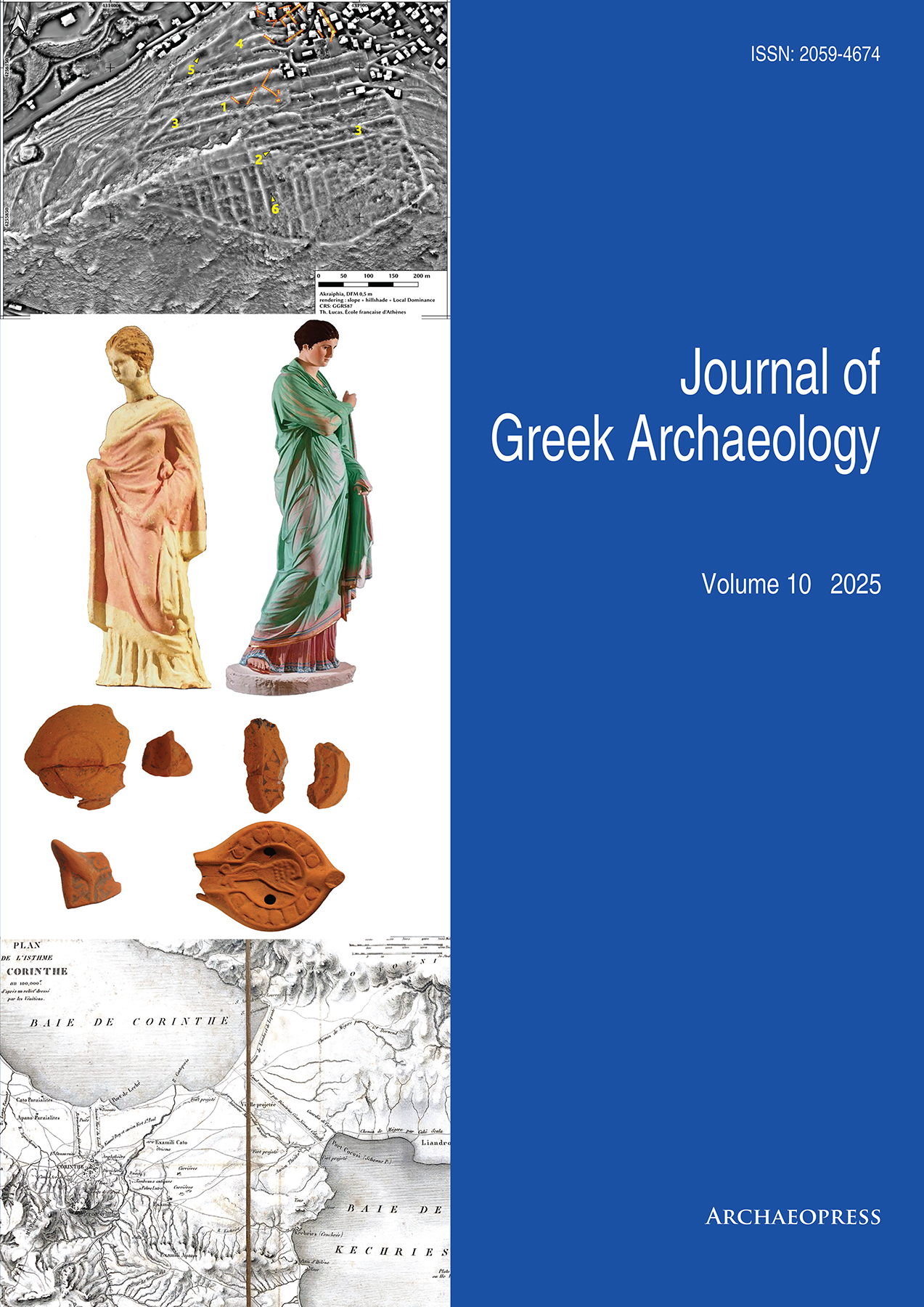
This paper provides a brief overview of lidar research developed in the framework of the Eretria-Amarynthos Survey Project (EASP). Over the course of four field seasons, the implementation of lidar-based remote sensing and ground-truthing has become an integral part of the examination of archaeological landscapes, resulting in significant advances in fieldwork practices, survey methodology, and data recording. We argue here that lidar holds great potential for archaeological survey in Greece, particularly in rugged and sloped terrain, which represents up to 80% of landforms in Central Greece, thus opening new ways of inquiry and dramatically increasing archaeological survey potential outside of agricultural and flat terrain.
References
Balta, E. 1989. L’Eubée à la fin du XVe siècle. Economie et population. Les registres de l’année 1474 (AEM Supplement 28). Athens.
Bennett, R., K. Welham, R.A. Hill and A. Ford 2012. A comparison of visualization techniques for models created from airborne laser scanned data. Archaeological Prospection 19: 41–48.
Caspari, G. 2023. The potential of new LiDAR datasets for archaeology in Switzerland. Remote Sensing 15: 1569.
Chezeaux, Ch. 2022. Les carrières antiques d’Érétrie: une étude micro-régionale de l’extraction de la pierre. Unpublished Master’s thesis, University of Lausanne.
Esri. 2022. ‘ArcGIS Pro’ (Version 3.2) [Software]. Environmental Systems Research Institute.
Fachard, S. 2023. Étudier un sanctuaire grec et son environnement: le cas de l’Artémision d’Amarynthos dans l’île d’Eubée (Grèce). Comptes rendus des séances de l’Académie des Inscriptions & Belles Lettres 4: 1353–1375.
Fachard, S. and A.R. Knodell. 2020. Out of Attica, in N. Papadimitriou, J.C. Wright, S. Fachard, N. Polychronakou-Sgouritsa and E. Andrikou (eds) Athens and Attica in Prehistory: Proceedings of the International Conference, Athens, 27–31 May 2015: 407–416. Oxford: Archaeopress.
Fachard, S., A.R. Knodell and E. Banou 2015. The 2014 Mazi Archaeological Project (Attica). Antike Kunst 58:178–86.
Fachard, S. and D. Pirisino 2015. Routes out of Attica, in M. Miles (ed.) Autopsy in Athens. Recent Archaeological Research on Athens and Attica: 139– 153. Oxford & Philadelphia: Oxbow Books,.
Fachard, S., A. Simosi, T. Krapf, D. Greger, T. Saggini, S. Verdan, J. André, O. Kyriazi and Th. Theurillat. 2022. The Artemision at Amarynthos: The 2021 Season. Antike Kunst 65:128–142.
Fachard, S., A. Simosi, T. Krapf, T. Saggini, O. Kyriazi, Ch. Chezeaux, J. André, D. Greger, S. Verdan and Th. Theurillat 2023. The Artemision at Amarynthos: The 2022 Season. Antike Kunst 66: 93–100.
Fachard, S., A. Simosi, T. Krapf, T. Saggini, O. Kyriazi, Ch. Chezeaux, J. André, D. Greger, S. Verdan and Th. Theurillat 2024. The Artemision at Amarynthos: The 2023 Season. Antike Kunst 67: 95–104.
Iriarte, J, M. Robinson, J. de Souza, A. Damasceno, F. da Silva, F. Nakahara, A. Ranzi and L. Aragao 2020. Geometry by design: contribution of lidar to the understanding of settlement patterns of the mound villages in SW Amazonia. Journal of Computer Applications in Archaeology 3(1): 151–169.
Knodell, A.R., S. Fachard and K. Papangeli 2016. The 2015 Mazi Archaeological Project: Regional Survey in Northwest Attica (Greece). Antike Kunst 59: 132–152.
Knodell, A.R, S. Fachard and K. Papangeli 2017. The 2016 Mazi Archaeological Project: survey and settlement investigations in northwest Attica (Greece). Antike Kunst 60: 146–63.
Knoepfler, D. 2018. Amarynthos trente ans après: l’épigraphie a tranché, mais Strabon n’aura pas à plaider coupable. CRAI: 883–952.
Kokalj, Ž. and M. Somrak 2019. Why not a single image? Combining visualizations to facilitate fieldwork and on-screen mapping. Remote Sensing 11(7): 747.
Kokalj, Ž., S. Džeroski, I. Šprajc, J. Štajdohar, A. Draksler and M. Somrak 2023. Machine learning-ready remote sensing data for Maya archaeology. Scientific Data 10: 558.
Krapf, T. and K. Reber. 2018. À la recherche du sanctuaire d’Artémis Amarysia: dix ans de fouilles à Amarynthos (Eubée). Comptes rendus des séances de l’Académie des Inscriptions & Belles Lettres 2018: 849–81.
Lock, P., 1989. The Medieval towers of Greece: a problem in chronology and function, Mediterranean Historical Review 4: 129–145.
Pickard, J. 1891. A Topographical Study of Eretria. American Journal of Archaeology 1st Series 7: 371–89. Python Software Foundation. Python Language Reference (Version 2.7). Available at http:// www.python.org
Rhodes, P.J. and R. Osborne (eds) 2018. Greek Historical Inscriptions 478-404 BC. Oxford, New York: Oxford University Press.
Štular, B., S. Eichert and E. Lozić. 2021a. Airborne LiDAR point cloud processing for archaeology: pipeline and QGIS toolbox. Remote Sensing 13: 3225.
Zakšek, K., K. Oštir and Z. Kokalj 2011. Sky-view factor as a relief visualization technique. Remote Sensing 3: 398-415.
Downloads
Published
How to Cite
Issue
Section